


There has been a major change in the Indian real estate investment landscape. For years, retail investors were deprived of Grade-A commercial properties – high-end IT parks, huge office complexes and premium retail malls – due to prohibitive “entry tickets” running into crores of rupees.
While traditional REITs (real estate investment trusts) filled some of this gap, they focused on larger, diversified portfolios. The introduction of the SM REIT (Small and Medium REIT) framework in 2024 by SEBI has officially democratized commercial real estate. Now, investors can own a “slice” of a specific, high-yield commercial building with an investment starting at just ₹10 Lakhs.
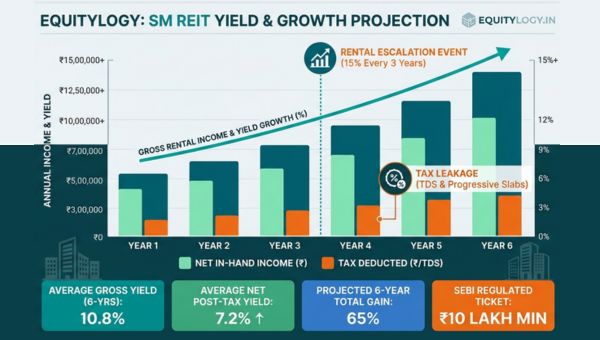
At EquityLogy, we believe SM REITs represent the most significant opportunity for yield-seeking investors in 2026. This guide breaks down everything you need to know about this emerging asset class.
What is SM REIT?
REIT is a SEBI-regulated investment vehicle that pools funds from at least 200 investors to acquire and SM manage income generating commercial real estate properties. The value of these properties usually ranges between ₹50 crore to ₹500 crore.
Think of it as “precision real estate investing.” Unlike traditional REITs, where your money is spread across 30 different buildings, an SM REIT allows you to invest in a single, specific property. You know exactly what building you are financing, who the tenants are and where it is located.
How does SM REIT work?
- Asset Identification: An investment manager identifies a completed, income-generating commercial property (such as a Grade-A office building).
- SPV formation: A special purpose vehicle (SPV) is formed to purchase the property.
- SEBI Registration: The scheme is registered with SEBI under the SM REIT framework, ensuring strict governance and transparency.
- Capital Pooling: Retail and HNI investors subscribe to units of the trust (minimum ₹10 lakh).
- Rental Distribution: The property earns rent from tenants. SEBI mandates that at least 95% of the net distributable cash flows must be paid out to investors, usually on a quarterly basis.
SM REIT Yield & Escalation Planner
EquityLogy: SM REIT Yield & Escalation Planner
Analyze pre-tax & post-tax returns under Indian Income Tax Slabs with Lease Escalations
SM REIT vs. Traditional REIT: The Comparison
Understanding the difference is crucial for portfolio allocation. While both provide exposure to commercial real estate, they serve different investment goals.
| Feature | SM REITs (Small & Medium) | Traditional REITs |
|---|---|---|
| Asset Strategy | Single-asset or small group of properties. | Large, diversified portfolio of assets. |
| Asset Value | ₹50 Cr – ₹500 Cr per scheme. | Minimum ₹500 Cr (usually much higher). |
| Min. Investment | ₹10 Lakhs. | Small (trades like a stock, ~₹300-400). |
| Liquidity | Moderate (traded on exchanges, but lower volume). | High (liquid, traded on NSE/BSE). |
| Investor Control | High (you choose the specific property). | Low (the REIT manager chooses assets). |
| Risk Profile | Concentrated (risk tied to one building/tenant). | Diversified (spread across many tenants/cities). |
How to Invest in SM REITs?
Investing in an SM REIT (Small and Medium Real Estate Investment Trusts) has become incredibly streamlined under the strict monitoring of SEBI. If you want to move beyond regular fractional ownership and add high-yield commercial real estate to your portfolio, here is the simplified roadmap to executing your investment through EquityLogy:
Step 1: Set Up Your Core Infrastructure
Because SM REIT units are electronic securities, you cannot purchase them using cash or standard banking transfers alone.
- Demat & Trading Account: You must have an active Demat account with a registered broker in India.
- KYC Verification: Ensure your central KYC (KRA) is updated with your pan card and active bank details.
Step 2: The Primary Market Route (IPO Launch)
When a new fractional ownership platform launches an SM REIT scheme (like recent market entries), it opens as an Initial Public Offering.
- Access Net-Banking: Log into your bank account and navigate to the ASBA (Application Supported by Blocked Amount) section.
- Determine Ticket Size: Apply for the scheme allotment. Keep in mind that SEBI mandates a minimum entry ticket size of ₹10 Lakh for SM REITs, unlike traditional REITs.
- Submit Bid: Select the retail/HNI category and submit your bid to block the funds.
Step 3: The Secondary Market Route (Stock Exchange)
If you miss the initial IPO window, you can purchase listed units seamlessly.
- Search the Ticker: Log into your trading terminal (Zerodha, Groww, etc.) and search for the listed SM REIT scheme name.
- Execute the Trade: Buy units directly from the secondary market during market hours. The units will hit your Demat account within T+1 days, making you an official co-owner of premium commercial assets.
The “SM REIT” Difference: Why Invest?
As of June 2026, the SM REIT market is in its early growth phase. SEBI has begun clearing draft offer documents for various schemes. Investors should watch for these names as they move from “Draft” to “Active” status on the stock exchanges:
- PropShare Celestia: A flagship scheme focusing on premium commercial office assets.
- PropShare Titania: Another high-yield commercial asset scheme by the PropShare platform.
- PropShare Platina: One of the earliest schemes to navigate the SEBI migration process.
EquityLogy Insight: Always check the “Objects of the Issue” in the offer document. Most SM REITs are acquiring fully leased buildings, which means your income starts from Day 1.
What are the Top 3 REITs in India?
If you prefer diversification over single-asset concentration, the traditional REIT market in India offers three giants that have set the gold standard for performance:
- Embassy Office Parks REIT: The pioneer. It owns massive IT parks in Bengaluru, Mumbai, and Pune, housing global tech giants like Microsoft and Google.
- Mindspace Business Parks REIT: Strong presence in Hyderabad and Pune. Known for high-quality “Work-Life” campuses that attract long-term corporate tenants.
- Nexus Select Trust: India’s first consumption-led REIT. Instead of offices, it owns high-performing retail malls across India, benefiting from the country’s growing middle-class spending.
Frequently Asked Questions (FAQs)
Does SM have a REIT?
Yes, “SM” stands for Small and Medium, referring to the size of the assets (₹50-500 Cr). Several platforms like PropShare and Strata are transitioning their assets into SEBI-regulated SM REIT schemes.
How do I invest in SM REIT?
You need a Demat account. Once an SM REIT scheme is listed on the stock exchange (NSE/BSE), you can buy units through your regular broker (like Zerodha, Groww, or Upstox) just like you buy shares.
Is SM REIT better than physical real estate?
For most investors, yes. SM REITs offer professional management, liquidity on the exchange, and lower ticket sizes (₹10 Lakhs) compared to the crores required for a Grade-A commercial property.