

The Sensex, often referred to as the indicator of the Indian economy, is the oldest stock market index in India. Whether you are a experienced investor or a beginner, keeping an eye on the Sensex index is critical for understanding the health of the Bombay Stock Exchange (BSE). As the stock market Sensex varies, it reflects the collective sentiment of millions of investors and the performance of India’s top blue-chip companies.
About Sensex
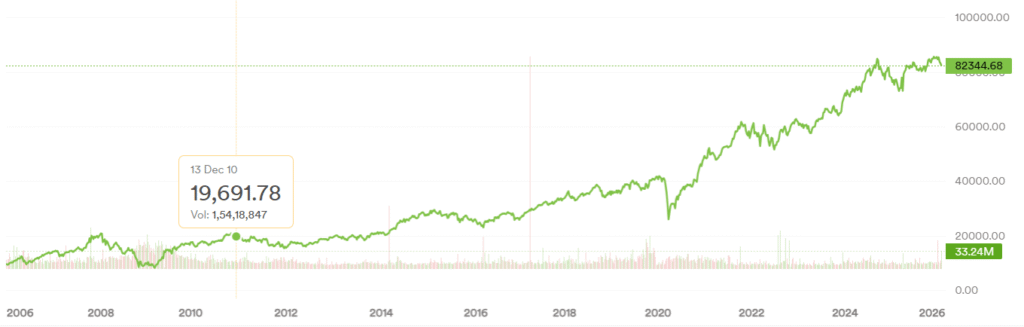
The word Sensex is a combination of Sensitive Index, coined by analyst Deepak Mohoni in 1986. Officially called as the S&P BSE SENSEX, it is a free float market-weighted index of 30 well established and financially complete companies listed on the Bombay Stock Exchange (BSE).
These companies represent several industrial sectors of the Indian economy. When people conversation about today’s Sensex being up or down, they are basically referring to the weighted average performance of these BSE 30 giants.
SENSEX Prediction – BSE Sensex Share/Stock Price LIVE Today 21-03-2026
Monitoring the Sensex today live is a daily ritual for traders. The Sensex share price moves in real-time from 9:15 AM to 3:30 PM IST on weekdays.
| Markets Today | 74,533 |
| High | 76,014.31 |
| Low | 75,324.73 |
| Open at | 75,826.68 |
| Prev Close | 75,502.85 |
Sensex Forecast Today – Support and Resistance Levels:
These are key price points where the index is likely to pause or reverse.
| Level | Sensex Support | Sensex Resistance |
|---|---|---|
| Level 1 | 74,183 | 75,085 |
| Level 2 | 73,833 | 75,636 |
| Level 3 | 73,282 | 75,986 |
Tracking the bse sensex today live allows investors to gauge market volatility. Platforms like moneycontrol sensex and sensex index moneycontrol provide heatmaps showing which of the 30 constituent stocks are driving the index. If you are looking for the sensex share rate or the stock price of sensex, you are looking at the index points that reflect the total market cap of its constituents relative to a base period.
Read Also – FinNifty
S&P BSE SENSEX (^BSESN) Historical Data
| Year | Jan | Mar | May | Jul | Sep | Nov | Dec | Annually |
|---|---|---|---|---|---|---|---|---|
| 2026 | -3.37% | NA | NA | NA | NA | NA | NA | -3.37% |
| 2025 | -0.82% | 5.76% | 1.51% | -2.90% | 0.57% | 2.11% | -0.57% | 9.06% |
| 2024 | -0.68% | 1.59% | -0.70% | 3.43% | 2.35% | 0.52% | -2.08% | 8.17% |
| 2023 | -2.12% | 0.05% | 2.47% | 2.80% | 1.54% | 4.87% | 7.84% | 18.74% |
| 2022 | -0.41% | 4.13% | -2.62% | 8.58% | -3.54% | 3.87% | -3.58% | 4.44% |
| 2021 | -3.07% | 0.83% | 6.47% | 0.20% | 2.73% | -3.78% | 2.08% | 21.99% |
| 2020 | -1.29% | -23.05% | -3.84% | 7.71% | -1.45% | 11.45% | 8.16% | 15.75% |
| 2019 | 0.52% | 7.82% | 1.75% | -4.86% | 3.57% | 1.66% | 1.13% | 14.38% |
| 2018 | 5.60% | -3.56% | 0.46% | 6.16% | -6.26% | 5.09% | -0.35% | 5.91% |
| 2017 | 3.87% | 3.05% | 4.10% | 5.15% | -1.41% | -0.19% | 2.74% | 27.91% |
Understanding the BSE SENSEX Stock Market Index
The BSE index is managed by Asia Index Private Limited, a joint venture between S&P Dow Jones Indices and BSE Ltd. While the midcap Sensex and other thematic indices exist, the Bombay Sensex index remains the most influential.
| Feature | S&P BSE Sensex Details |
|---|---|
| Full Name | S&P Bombay Stock Exchange Sensitive Index |
| Number of Stocks | 30 (The BSE 30) |
| Base Year | 1978-1979 |
| Base Value | 100 |
| Calculation Method | Free-float Market Capitalization |
| Rebalancing | Semi-annually (June and December) |
What is Sensex based on?
The Sensex stock index is calculated using the Free-float Market Capitalization method. Different the full market cap method, this only considers shares that are offered for the public to trade (excluding promoter holdings, government holdings, and locked-in shares).
To find the BSE Sensex now value, the exchange takes the total free-float market value of all 30 companies and divides it by a Free-float Market Index Divisor, which confirms continuity despite corporate actions like stock splits.
SENSEX Prediction For 2026, 2027, and 2028
SENSEX prediction by month in Year 2026.
| Month | Min-Max | Close |
|---|---|---|
| Feb 2026 | 77580-93611 | 86290 |
| Mar 2026 | 76438-95649 | 88558 |
| Apr 2026 | 77199-90633 | 83920 |
| May 2026 | 76799-90153 | 83476 |
| Jun 2026 | 78348-91992 | 85169 |
| Jul 2026 | 81207-95338 | 88277 |
| Aug 2026 | 81831-96063 | 88957 |
| Sep 2026 | 81898-96133 | 89112 |
| Oct 2026 | 82678-97052 | 89865 |
| Nov 2026 | 84927-99698 | 92317 |
| Dec 2026 | 86217-101199 | 93713 |
SENSEX prediction by month in Year 2027.
| Month | Min-Max | Close |
|---|---|---|
| Jan 2027 | 90990-106824 | 98912 |
| Feb 2027 | 94513-110939 | 102741 |
| Mar 2027 | 95816-112580 | 104178 |
| Apr 2027 | 96126-112838 | 104490 |
| May 2027 | 96512-113299 | 104924 |
| Jun 2027 | 97015-113888 | 105461 |
| Jul 2027 | 91405-107296 | 99378 |
| Aug 2027 | 93509-109777 | 101650 |
| Sep 2027 | 94077-110444 | 102269 |
| Oct 2027 | 96908-113773 | 105346 |
| Nov 2027 | 104138-122245 | 113198 |
| Dec 2027 | 103406-121380 | 112399 |
SENSEX prediction by month in Year 2028.
| Month | Min-Max | Close |
|---|---|---|
| Jan 2028 | 1,02,000-1,05,500 | 113109 |
| Feb 2028 | 1,03,500-1,07,000 | 113522 |
| Mar 2028 | 1,05,000-1,08,500 | 116850 |
| Apr 2028 | 1,06,200-1,10,000 | 134378 |
| May 2028 | 1,07,500-1,11,500 | 116050 |
| Jun 2028 | 1,09,000-1,13,000 | 116509 |
| Jul 2028 | 1,10,500-1,14,500 | 128028 |
| Aug 2028 | 1,12,000-1,16,000 | 141039 |
| Sep 2028 | 1,13,500-1,18,000 | 159208 |
| Oct 2028 | 1,15,000-1,20,000 | 145437 |
| Nov 2028 | 1,16,500-1,22,500 | 128004 |
| Dec 2028 | 1,18,000-1,25,000 | 130194 |
SENSEX Companies List
| Company Name | Market Cap (Cr) | Current Price (% Change) | Sector |
|---|---|---|---|
| Reliance Industries | ₹18,90,559 Cr | ₹1,391.00 | Refineries |
| HDFC Bank | ₹14,35,056 Cr | ₹935.50 | Banks |
| Bharti Airtel | ₹11,76,945 Cr | ₹1,967.90 | Telecom-Service |
| Tata Consultancy Services | ₹11,57,734 Cr | ₹3,144.40 | IT – Software |
| State Bank of India | ₹9,81,030 Cr | ₹1,066.20 | Banks |
| ICICI Bank | ₹9,78,029 Cr | ₹1,383.60 | Banks |
| Infosys | ₹6,75,671 Cr | ₹1,659.50 | IT – Software |
| Bajaj Finance | ₹5,81,895 Cr | ₹935.15 | Finance |
| Hindustan Unilever | ₹5,59,285 Cr | ₹2,352.60 | FMCG |
| Larsen & Toubro | ₹5,21,859 Cr | ₹3,932.90 | Infrastructure |
| HCL Technologies | ₹4,69,573 Cr | ₹1,721.60 | IT – Software |
| Maruti Suzuki India | ₹4,67,730 Cr | ₹14,502.00 | Automobile |
| Mahindra & Mahindra | ₹4,28,850 Cr | ₹3,384.40 | Automobile |
| Kotak Mahindra Bank | ₹4,10,152 Cr | ₹412.40 | Banks |
| Axis Bank | ₹4,10,064 Cr | ₹1,363.70 | Banks |
| ITC | ₹4,02,501 Cr | ₹318.60 | Tobacco Products |
| Sun Pharmaceutical Industries | ₹3,86,329 Cr | ₹1,589.30 | Pharmaceuticals |
| UltraTech Cement | ₹3,76,283 Cr | ₹12,717.00 | Cement |
| Titan Company | ₹3,53,046 Cr | ₹3,939.70 | Diamond, Gems and Jewellery |
| NTPC | ₹3,37,638 Cr | Power Generation & Distribution | |
| Bharat Electronics | ₹3,31,425 Cr | ₹444.50 | Aerospace & Defence |
| Adani Ports and Special Eco… | ₹3,18,315 Cr | ₹1,417.80 | Marine Port & Services |
| Bajaj Finserv | ₹3,10,152 Cr | ₹1,948.10 | Finance |
| Eternal (Zomato) | ₹2,57,134 Cr | ₹275.35 | E-Commerce/App based Aggregator |
| Tata Steel | ₹2,41,936 Cr | ₹202.32 | Steel |
| Power Grid Corporation of India | ₹2,41,583 Cr | ₹260.50 | Power Generation & Distribution |
| Asian Paints | ₹2,40,840 Cr | ₹2,416.00 | Paints/Varnish |
| Interglobe Aviation | ₹1,83,571 Cr | ₹4,621.00 | Air Transport Service |
| Tech Mahindra | ₹1,72,675 Cr | ₹1,768.40 | IT – Software |
| Trent | ₹1,37,335 Cr | ₹3,823.80 | Retail |
Frequently Asked Questions about Sensex Forecast
What is the prediction for Sensex?
In the short term, the Sensex today India performance depends on quarterly corporate earnings and Union Budget announcements. Experts suggest a buy on dips strategy as India remains a bright spot in the global economy.
What will be Sensex in 2030?
To find the BSE Sensex now value, the exchange takes the total free-float market value of all 30 companies and divides it by a Free-float Market Index Divisor, which confirms continuity despite corporate actions like stock splits.
What is the difference between BSE and Sensex?
BSE is the exchange, while Sensex is the index that tracks the performance of the top 30 companies on that exchange.
How can I invest in Sensex?
You cannot buy the index itself directly. However, you can invest in Sensex Index Funds or Exchange Traded Funds that mimic the composition of the BSE stock exchange index.
Who manages the Sensex?
It is managed by Asia Index Pvt. Ltd, a venture between S&P Dow Jones Indices and the BSE.
Is Nifty better or Sensex?
Both are major indices. Sensex tracks 30 companies, while Nifty 50 tracks 50. They generally move in the same direction, but Nifty is slightly more diversified across sectors.
What is the prediction for Sensex?
Short-term: Neutral to bearish. Long-term: Upward, with targets around 107,000 by end-2026.
What will be Sensex in 2030?
Projections range from 116,000 to 150,000, assuming 12-15% CAGR, supported by India’s economic expansion.