

Expense Tracker Apps in India: There is a specific kind of dread that hits you around the 25th of the month. Salary week feels like a distant memory. You open your bank app, see a number that shouldn’t be that low, and think: “Where did it all go?”
A Swiggy run here. A quick-commerce order there. A few Myntra buys during the sale. A Spotify upgrade. By themselves, each decision made sense. Together, they quietly swallowed a third of your income — and you have nothing to show for it.
The fix isn’t willpower. It’s awareness. And the fastest path to financial awareness in 2026 is an expense tracker app that works with your habits, not against them.
This guide reviews 11 of the best expense tracker apps available for Indian users — not just a feature list, but honest pros, real cons, and a clear answer to the question every reader actually has: “Which one is right for me?”
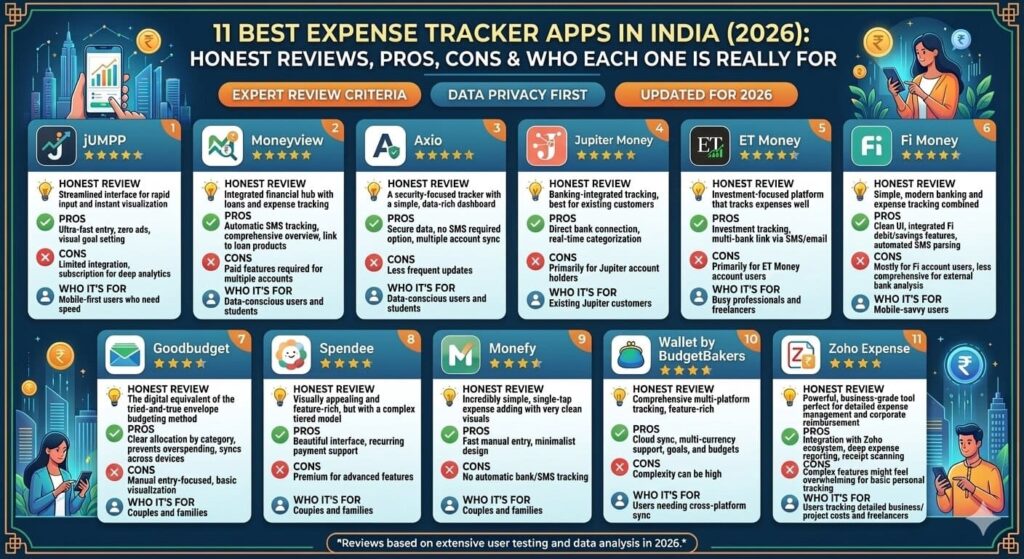
1. jUMPP — Best AI-Powered All-in-One Finance Super App
| Best for: Users who want AI-driven insights, voice queries, automated budgeting, and a full financial super-app in one place |
jUMPP is arguably the most ambitious personal finance app built specifically for the Indian market. Where most trackers stop at recording what you spent, jUMPP uses AI to predict what you’re about to spend, suggest a budget tailored to your actual habits, and proactively flag when you’re drifting off course — before the damage is done.
At the heart of jUMPP is jAI — an AI financial assistant that you can talk to in plain language (English and Hindi). Ask it “How much did I spend on dining out last month?” or “Am I on track for my savings goal?” and it answers instantly, pulling from your real transaction data. The voice command support makes it feel less like a finance app and more like having a knowledgeable friend who happens to know your entire spending history.
jUMPP auto-categorises expenses into 5 fixed categories and up to 8 personalised categories that adapt to your behaviour over time — with up to 90% categorisation accuracy reported by users. Its jAIlytics dashboard surfaces monthly savings trends, average daily spend, and overall financial health scores in a visual, digestible format.
Beyond tracking, jUMPP layers in a full suite of financial tools: “Loan It” for quick borrowing, “Pay Fast” for instant UPI payments, “Invest Up” to grow your savings, and “Save On” for smart saving recommendations. It’s the closest thing India has to a true financial super-app that doesn’t require opening a new bank account.
| Pros | Cons |
|---|---|
| jAI voice assistant answers spending questions in real time | Newer app — smaller user base than Moneyview or Axio |
| AI predicts future expenses and suggests personalised budgets | AI features are most powerful after a few months of data |
| Auto-categorisation with up to 90% accuracy | Some advanced features still maturing |
| Net worth tracking alongside daily expense management | Heavy feature set may feel overwhelming to minimalists |
| Full suite: loans, payments, investing, and savings in one app | Loan and investing nudges present within the app |
| Built ground-up for the Indian market and UPI ecosystem |
Start Tracking Your Expenses Smartly – Download the Expense Tracker App Today!
2. Moneyview — Best Overall for Zero-Effort SMS Tracking
| Best for: Salaried professionals, anyone who wants zero manual entry |
Moneyview has been around since 2014 and has earned its spot at the top of almost every India-specific ranking. The reason is simple: it does the hard work for you. Once you grant SMS permission, the app quietly reads every bank transaction message and sorts it into categories — groceries, fuel, EMI, online shopping — without you lifting a finger.
The UI is clean and non-intimidating, which matters for users who aren’t finance nerds. Weekly and monthly summaries are visual and easy to digest. It also connects to multiple bank accounts, so your HDFC salary account and ICICI credit card are both in one view.
One important note: Moneyview also offers instant personal loans. This is a revenue model, not a reason to avoid it, but be aware that you may see loan nudges within the app.
| Pros | Cons |
|---|---|
| Auto-tracks via SMS with high accuracy | Loan promotions can feel intrusive |
| Supports all major Indian banks | Limited investment tracking |
| Clean, beginner-friendly UI | No desktop/web version |
| Free with no critical features paywalled | Customisation of categories is limited |
| Weekly spending summaries are very actionable |
3. Axio (formerly Walnut) — Best Pure Tracker App
| Best for: People who want pure, accurate expense tracking with no clutter |
Walnut built a loyal user base across India before rebranding to Axio. It works the same way as Moneyview — SMS-based automatic tracking — but the experience is leaner and more focused. There’s less selling inside the app.
Axio now also tracks BNPL (Buy Now Pay Later) purchases, which is increasingly important as apps like LazyPay and Simpl become mainstream. It also offers credit score tracking, making it a smart pick for users who are building or monitoring their credit profile.
With over 10 million users, it’s battle-tested and reliable. The expense categorisation accuracy is among the best in class.
| Pros | Cons |
|---|---|
| Excellent SMS-based auto-tracking | Interface feels slightly dated compared to newer apps |
| BNPL and credit card tracking | No investment tracking |
| Credit score monitoring included | Bill split feature could be more polished |
| 10M+ user base = well-tested reliability | Advanced reports require premium |
| Minimal upselling |
4. Jupiter Money — Best for Salaried Users Who Want to Save Automatically
| Best for: Young professionals who want expense tracking + automated savings in one account |
Jupiter is more than a tracker — it’s a neobank with a savings account, a debit card, and built-in AI-powered expense analytics. If you’re willing to move (or add) a savings account to Jupiter, you get one of the most seamless money management experiences available in India today.
The standout feature is “Pots” — virtual buckets where you can earmark money for goals like a vacation, emergency fund, or a gadget purchase. Pots removes the mental burden of remembering what different tranches of your savings are for.
Jupiter also rewards you with jewels (reward points) for good financial behaviour, which is a clever gamification hook that genuinely helps users stay engaged with their finances.
| Pros | Cons |
|---|---|
| Beautiful, modern UI | Requires opening a Jupiter account to unlock full features |
| Savings Pots are genuinely useful | Limited to Federal Bank partnership for now |
| AI-powered spending insights | Not ideal if you want to track across all your existing banks |
| Rewards for healthy financial habits | Some features still maturing |
| 2% cashback on debit card spends |
5. ET Money — Best for Investors Who Also Want to Track Expenses
| Best for: Anyone who wants expense tracking + mutual fund investing in one place |
ET Money (by Times Internet) sits at a unique crossroads: it’s a full-featured expense tracker and India’s largest direct mutual fund investment platform in one app. If you want to track your spending and route the savings directly into SIPs, ET Money removes all friction from that journey.
The expense tracking is SMS-based and automatic, with solid categorisation. But where ET Money truly shines is the investing side — you can set up mutual fund SIPs, track portfolio performance, buy insurance, and file taxes, all without leaving the app.
For the financially ambitious Indian in their late 20s or 30s trying to build wealth while also getting spending under control, ET Money is arguably the most complete single-app solution available.
| Pros | Cons |
|---|---|
| SMS auto-tracking + mutual fund investing in one app | The investment focus can overshadow the expense tracking |
| Direct plan mutual funds (lower expense ratios) | UI can feel dense for beginners |
| Insurance and tax filing features | Savings account not included (pure tracking + investing only) |
| Goal-based investing tools | Loan products are pushed frequently |
| Trusted Times Internet brand |
6. Fi Money — Best for Tech-Savvy Users Who Love Automation
| Best for: Young professionals who want to automate saving and investing rules |
Fi Money is the most technically sophisticated app on this list. Its “FIT Rules” feature lets you create automated savings triggers based on your own behaviour. Examples: “Every time I spend on food delivery, transfer ₹50 to my emergency fund.” Or: “Every Friday, round up my balance to the nearest ₹1,000 and invest the difference in a liquid fund.”
This behaviour-linked automation is psychologically brilliant. It turns your spending habits into a saving mechanism, rather than making you feel guilty about them.
Fi also has a neobank account (via Federal Bank), a debit card, and a clean AI assistant (“Ask Fi”) that can answer questions about your spending in plain English. If you said “How much did I spend on chai last month?”, Ask Fi would actually tell you.
| Pros | Cons |
|---|---|
| FIT Rules for automated savings based on your behaviour | Must open a Fi account to use it fully |
| Ask Fi: AI chatbot for expense queries | Federal Bank partnership limits some banking features |
| Modern, delightful UI | Smaller user base than Moneyview/Axio |
| Automatic round-ups into investments | Some features feel like they’re still being built out |
| No-forex-fee debit card is a bonus for travellers |
7. Goodbudget — Best for Disciplined Manual Budgeters
| Best for: Couples, families, and anyone who wants to follow the envelope budgeting method |
Goodbudget is philosophically different from every other app on this list. It doesn’t link to your bank accounts. It doesn’t read your SMS. You enter every expense manually.
This sounds like a drawback — and for some users, it is. But research consistently shows that manual expense entry increases financial mindfulness. The very act of typing “₹340 on Zomato” makes you acknowledge the purchase in a way that automatic tracking sometimes doesn’t.
Goodbudget uses the envelope method — a classic budgeting framework where you allocate fixed amounts to categories at the start of the month (groceries: ₹8,000; dining: ₹3,000; transport: ₹4,000) and track against them in real time. When the envelope is empty, you’re done for that category.
It syncs across devices, which makes it perfect for couples or families who want to share a budget — both partners can see the same envelopes and enter expenses from their own phones.
| Pros | Cons |
|---|---|
| Envelope method enforces strict, intentional budgeting | 100% manual entry can be tedious |
| Syncs across devices for couples/families | No automatic transaction import |
| Available on iOS, Android, and web | Free version limited to 10 envelopes |
| No bank account linking = zero data risk | No Indian-specific categories by default |
| Encourages spending mindfulness | Not ideal if you make 30+ transactions a day |
8. Spendee — Best for Visual Thinkers and Shared Expenses
| Best for: Visual learners, flatmates splitting expenses, and users with crypto wallets |
Spendee is one of the most aesthetically polished expense trackers available. If you’re the kind of person who processes information through charts and colours rather than rows of numbers, Spendee’s interface will immediately feel right.
Its standout feature for Indian users is shared wallets — you can invite flatmates, travel companions, or your partner to a shared wallet and track group expenses in real time. This removes the awkwardness of “who owes whom” in shared living situations.
Spendee also connects to cryptocurrency wallets, which makes it one of the few apps that can give crypto-active Indians a unified view of their complete financial picture.
| Pros | Cons |
|---|---|
| Beautiful, visual-first interface | Bank sync in India can be inconsistent |
| Shared wallets for group/family budgeting | Premium plan needed for full features (₹500–600/month) |
| Crypto wallet integration | No SMS auto-tracking (Indian banks) |
| Bank account syncing across multiple institutions | Customer support response times vary |
| Budget alerts with visual progress bars |
9. Monefy — Best for Total Simplicity
| Best for: Users who want a no-fuss, one-tap expense logger with zero learning curve |
Monefy does one thing and does it brilliantly: it lets you log expenses in under five seconds. Open the app, tap the category icon (food, transport, health, entertainment), enter the amount, done. The home screen is a colourful pie chart that immediately shows where your money is going.
There are no bank connections, no SMS reading, no setup. It’s as close to a digital version of your grandmother’s expense diary as you can get — except prettier.
This simplicity is a genuine strength for users who have tried “smarter” apps and abandoned them because of setup friction. Monefy gets out of the way and lets you build the habit first.
| Pros | Cons |
|---|---|
| Fastest expense entry of any app tested | 100% manual — no auto-tracking |
| Intuitive pie chart home screen | Limited reporting depth |
| Works completely offline | Syncing across devices requires premium (₹350/year) |
| Multi-currency support | Not designed for complex financial analysis |
| No account sign-up required to start | No investment or savings features |
10. Wallet by BudgetBakers — Best for Power Users Who Want Deep Analytics
| Best for: Detail-oriented users who want rich reports, custom categories, and multi-account management |
Wallet is the most comprehensive general-purpose finance app on this list. It connects to over 15,000 banks worldwide (yes, including major Indian banks), automatically categorises transactions, tracks every type of account — savings, current, credit card, cash, investment — and generates detailed analytics that most competing apps can’t match.
The reporting depth is impressive: you can analyse spending by category, account, time period, or even individual merchant. Bill management and subscription tracking are baked in. You can share specific account views with family members or partners, which is useful for joint household budgeting.
The trade-off is that Wallet has a steeper learning curve than most other apps on this list. It rewards users who invest time in setting it up correctly.
| Pros | Cons |
|---|---|
| Most comprehensive analytics on this list | More complex setup than Indian-specific apps |
| Connects to 15,000+ banks including Indian ones | Premium plan (₹700–800/month) needed for full bank sync |
| Bill and subscription reminders | SMS auto-tracking less reliable for Indian banks than Moneyview |
| Family/partner sharing features | Can feel overwhelming for beginners |
| Custom categories and sub-categories |
11. Zoho Expense — Best for Freelancers and Small Business Owners
| Best for: Freelancers, consultants, and small business owners who need to track and report business expenses |
Every other app on this list is built for personal finance. Zoho Expense is built for business use — and it shows. Receipt scanning (with OCR), mileage tracking, multi-currency support, expense reports, GST tracking, and approval workflows make it the definitive choice for anyone managing business expenses in India.
If you’re a freelance designer billing clients in dollars, a consultant submitting expense reports to a multinational, or a small shop owner tracking purchases for GST returns, Zoho Expense will save you hours every month that you currently spend on spreadsheets.
For pure personal expense tracking, it’s overkill. But if your financial life has a professional dimension, no other app on this list comes close.
| Pros | Cons |
|---|---|
| Excellent receipt scanning with multilingual OCR | Overkill for personal use only |
| GST tracking built in — crucial for Indian businesses | Free plan limited to 3 users and 5 receipts/month |
| Mileage tracking (manual and GPS) | Interface can feel corporate and dense |
| Approval workflow for team expense management | Best features require paid plan (₹750+/user/month) |
| Deep integration with Zoho Books and other Zoho products | No SMS auto-tracking for personal accounts |
Quick Comparison: All 11 Tracker Apps in India at a Glance
| App | Auto-Track (SMS) | Free Tier | Best For | Investing | Rating |
|---|---|---|---|---|---|
| jUMPP | Yes ✔ | Excellent | AI insights + super-app | Yes ✔ | 4.6/5 |
| Moneyview | Yes ✔ | Excellent | Salaried / All-round | Loans only | 4.7/5 |
| Axio | Yes ✔ | Very Good | Pure tracking + BNPL | No | 4.5/5 |
| Jupiter | With account | Good | Auto-save + neobank | Yes | 4.6/5 |
| ET Money | Yes ✔ | Good | Track + invest (MF) | Yes ✔ | 4.4/5 |
| Fi Money | With account | Good | Tech-savvy / automation | Yes | 4.5/5 |
| Goodbudget | No (manual) | 10 envelopes | Couples / envelope | No | 4.3/5 |
| Spendee | Partial | Limited | Visual / shared wallets | No | 4.2/5 |
| Monefy | No (manual) | Good | Simplicity / beginners | No | 4.4/5 |
| Wallet | Partial | Limited | Power users / analytics | No | 4.3/5 |
| Zoho Expense | No | 3 users / 5 receipts | Freelancers / SMBs | No | 4.4/5 |
Final Thoughts
The best expense tracker apps in India is the one you’ll actually use. A beautifully designed app you abandon after 10 days does nothing for your finances. A simple one you open every evening before bed can change your financial life within a month.
Start with jUMPP if you want an AI co-pilot that learns your habits and guides you proactively — it’s the most future-ready app on this list. Prefer battle-tested simplicity? Moneyview is your friend. Ready to make savings work harder? ET Money or Fi Money. Couple budgeting together? Goodbudget. Running a business on the side? Zoho Expense will pay for itself many times over.
However you choose to track: start today. Not next month. Not after the next salary credit. Today.
Which App Is Right for You? A 60-Second Decision Guide
Do you want AI to guide your finances proactively?
jUMPP. It predicts expenses, coaches you with jAI, and tracks your net worth — all in one place.
Do you want zero manual effort with proven reliability?
Moneyview or Axio. Both auto-track via SMS and have millions of happy users.
Are you also looking to invest or save automatically?
Jupiter (neobank + Pots), Fi Money (FIT Rules), or ET Money (mutual funds).
Do you manage business expenses?
Zoho Expense, no contest.
Note
- If you’re a couple or family: Goodbudget (envelope method + shared sync) or Spendee (shared wallets).
- If you’re a beginner who keeps abandoning finance apps: Monefy. Start simple. Build the habit first.
- If you’re a data nerd who wants maximum control: Wallet by BudgetBakers